
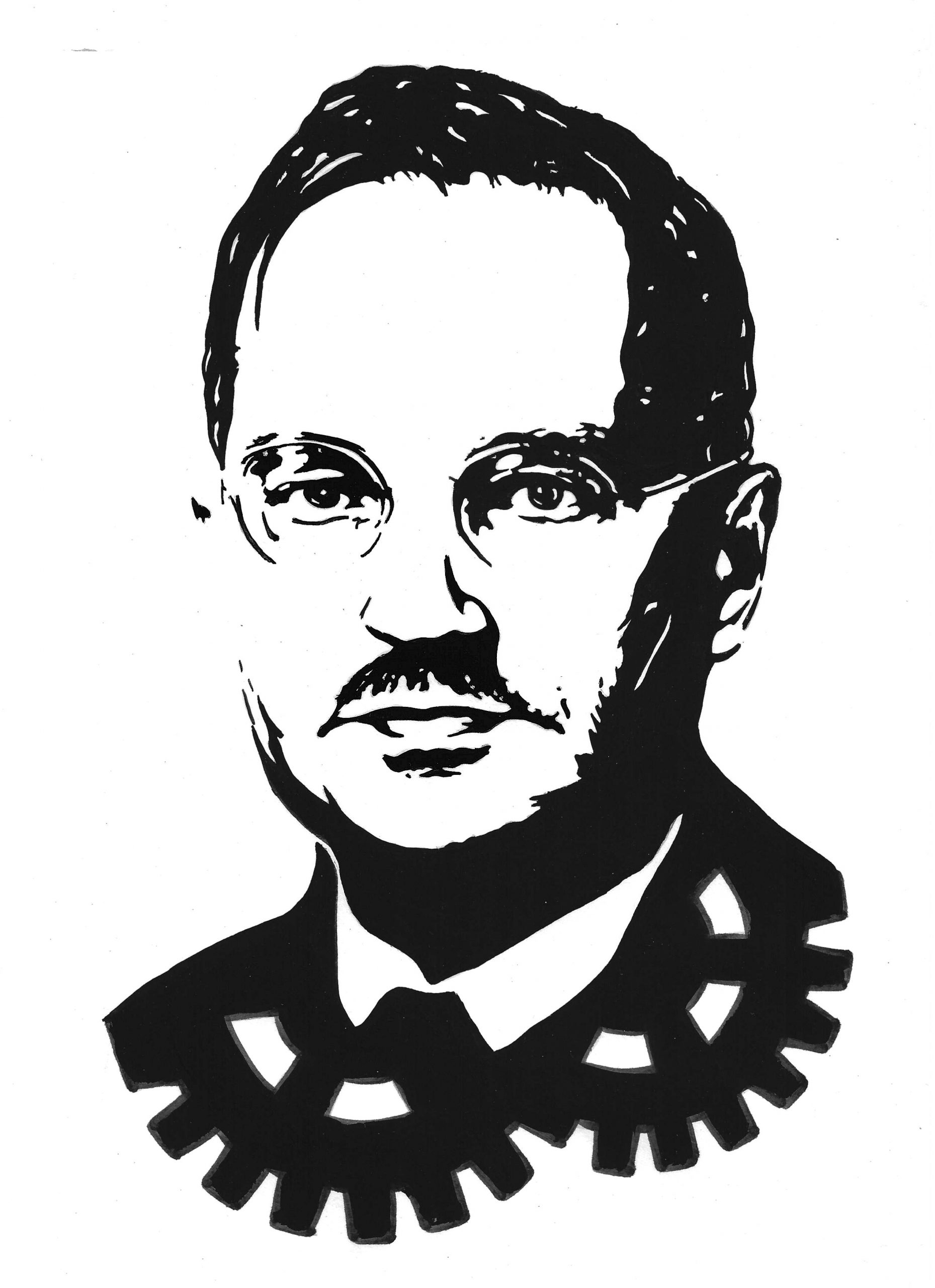
Este considerat unul dintre marii fondatori ai statisticii moderne. A introdus pentru prima dată conceptul modern de interval de încredere în testarea ipotezelor statistice.
He is considered one of the great founders of modern statistics. He introduced the modern concept of the confidence interval in statistical hypothesis testing.
Он считается одним из крупнейших основателей современной статистики. Он впервые ввёл современное понятие доверительного интервала в проверке статистических гипотез.
Jerzy Neyman s-a născut la 16 aprilie 1894 în Bender (cunoscut și ca Tighina până în 1812), un mic oraș de pe malul drept al Nistrului, în provincia Basarabia (situată între râurile Nistru și Prut) din Imperiul Rus (în prezent în Republica Moldova). Tatăl său, Marian-Ceslav, fiul lui Ghermaghen Neyman, s-a născut în satul Sidorovka, județul Kanev, lângă Kiev, și a fost avocat. Între 1892 și 1897, acesta a lucrat ca investigator criminalist în Chilia (un mic oraș pe brațul Chilia al Dunării, în deltă) și la Tighina. Mama lui Jerzy, Kazimira, fiica lui Kazimir, avea numele de fată Liutoslavska și s-a născut tot în provincia Kiev, în județul Cerkasî.
În 1897, tatăl lui Jerzy a fost mutat cu serviciul la Harkov. Aici, fiul său a absolvit gimnaziul nr. 3. În 1912, a intrat la facultatea de fizică și matematică a Universității din Harkov, unde a urmat cursurile lui D.M. Sințov, S.N. Bernstein și T.K. Rusanov, cel din urmă fiind, de asemenea, un absolvent al gimnaziului din Chișinău (1885). În timpul absolvirii, Neyman a pregătit pentru publicare cursul de prelegeri al lui T.K. Rusanov, „Calcul diferențial” (340 de pagini), publicat de „Societatea Studenților Matematicieni pentru ajutor reciproc”. O medalie de aur a fost menționată pentru lucrarea sa de licență (candidat), scrisă în 1916 sub îndrumarea lui T.K. Rusanov. După 1 septembrie 1917, a fost angajat ca profesor asistent la Departamentul de Matematică al Universității Tehnice din Harkov. Ulterior, și-a susținut examenul de magister.
În 1921, Neyman a părăsit Harkovul pentru Polonia. În perioada 1921-1923, a fost statistician la Institutul Agricol din Bydgoscz. În 1923, și-a susținut lucrarea de doctorat „Argumentarea și aplicarea teoriei probabilităților pentru rezolvarea problemelor de experiment agricol”, publicată în Jurnalul Agricol și Forestier Polonez în 1923, vol. 10. Între 1923 și 1934, a fost profesor asistent la Universitatea din Varșovia, lucrând în același timp la Institutul pentru Probleme Sociale „M. Nensky” și la Laboratorul de statistică al Școlii Principale de Agricultură. După 1924, a primit o bursă de la Fundația pentru Cultură Populară, care i-a permis să călătorească anual la Londra pentru a colabora cu E.K. Pearson, celebru matematician, biolog și filosof. În 1926-1927, susținut de o bursă Rockefeller, a călătorit la Londra și ulterior la Paris pentru a audia cursurile lui Lebesgue și seminariile lui Hadamard.
După întoarcerea în Polonia, a predat la Universitatea Jagiellonă din Cracovia. În acea perioadă a început o colaborare de mare succes cu E.K. Pearson, care i-a propus să cerceteze testarea ipotezelor statistice. În 1930, Jerzy Neyman a participat la primul Congres Matematic, unde a prezentat lucrarea „Despre verosimilitatea ipotezelor”. La o sesiune a „Uniunii liber-cugetătorilor”, a vorbit despre costurile statului pentru susținerea Bisericii Catolice, după care a emigrat în Anglia. Între 1934 și 1938, a fost lector și ulterior conferențiar la Universitatea din Londra.
Jerzy Neyman este unul dintre cei mai mari statisticieni moderni și fondatorul Teoriei Matematice a Selecției. Termenii „Testul Neyman-Pearson”, „Teoria Neyman-Pearson” și „Procedura Neyman-Keuls” îi poartă numele. Neyman a scris cărți binecunoscute despre teoria probabilităților și statistica matematică. Este autorul a peste 160 de lucrări despre teoria probabilităților și statistică matematică și aplicațiile acestora în biologie, meteorologie, astronomie, filosofie și științe sociale.
În august 1938, a fost ales profesor de statistică cu sarcini în Laboratorul de Statistică al Universității California din Berkeley. Începând cu 1945, din 5 în 5 ani, au fost inițiate sub egida lui Neyman simpozioane internaționale privind Statistica Matematică și Teoria Probabilităților. Neyman a fost redactor-șef al Proceedings-urilor acestor simpozioane. A fost, de asemenea, editorul Volumului Jubiliar de Lucrări Selectate dedicat lui Nicolae Copernic, publicat de Academia Națională de Științe a SUA în 1973-1974. În 1961, a fost desemnat Profesor Emeritus al Universității California din Berkeley.
Jerzy Neyman a fost ales Doctor Honoris Causa al Institutului de Statistică din India (1956) și al universităților din Chicago (1960), Stockholm (1964) și Varșovia (1974). A fost, de asemenea, membru onorific al Societății Regale de Statistică din Londra și al Societății Matematice din Londra. În 1964, a fost ales membru al Academiei Naționale de Științe a SUA. În același an, a fost ales membru străin al Academiilor de Științe din Polonia și Suedia. În 1968, a fost decorat cu Medalia Națională pentru Știință a SUA. Neyman a aplicat statistica în cosmologie (vezi, de exemplu, „Stochastic approach to Cosmology” în Proc. of the Conference on mathematical models in Physical Sciences, N.Y., Prentice Hall, 1963). În 1975, a fost ales membru al Uniunii Astronomice Internaționale și, în același an, Președinte de Onoare al Institutului Internațional de Statistică.
(asm.md)
Jerzy NEYMAN – EN
He is considered one of the great founders of modern statistics. He introduced the modern concept of the confidence interval in statistical hypothesis testing.
Jerzy Neyman was born on 16 April 1894 in Bender (actually and till 1812 Tighina), a small town on the right-side border of the Dniester River in Bessarabia province (located between the Dniester and Prut rivers) of Tsar Russia (actually in the Independent Republic of Moldova). His father Marian-Ceslav son of Ghermaghen Neyman was born in village of Sidorovka Kanev County near Kiev. He was a lawyer. In 1892-1897 he worked as a criminal investigator in Chilia (a small city on Chilia branch of the Danube River in the Danube delta) and Tighina. The mother of Jerzy, Kazimira, daughter of Kazimir, had the maiden name Liutoslavska. She was born also in Kiev province in the county of Cherkassk.
In 1897 Jerzy’s father was moved by his job to Kharkov. Here his son finished the gymnasium no. 3. In 1912 he entered the physical and mathematical department of the Kharkov University, where he studied the courses by D.M. Sintsov, S.N. Bernstein, T. K. Russian, who finished also the gymnasium in Chisinau in 1885. During his graduation Neyman prepared for publication the lecture course by T.K. Russian on “Differential calculus” on 340 pages, which was published by the “Mathematical Student Society for mutual support”. The gold medal mentioned his license (candidate) thesis, written in 1916 under the auspices of T.K. Russian. After 1 September 1917 he was engaged as assistant professor at the Department of Mathematics of the Kharkov Technical University. Thereafter he held his magister examination. In 1921 Neyman left Kharkov for Poland. In 1921-23 he was statistician at the Agricultural Institute in Bydgoscz. In 1923 he held his doctoral work “The argumentation and the application of the probability theory for solving of the agricultural experiment problems”, which was published in Polish Agricultural Forest Journal in 1923, vol. 10. In 1923-1934 he was assistant professor at the Warsaw University and at the same time worked at the Institute for Social problems named after “M. Nensky” and the statistical Laboratory of the Main Agricultural School. After 1924 he had a grant from the Popular culture Foundation which permitted him to travel to London each year to collaborate with E.K. Pearson, famous mathematician, biologist and philosopher. In 1926-1927 he was supported by a Rockefeller grant and traveled to London and thereafter to Paris to listen to the courses by Lebesgue and the seminars by Hadamard. After his coming back to Poland he taught at the Jagellonian University in Krakov. This time he collaborates very successfully with E.K. Pearson, which proposed him to investigate the testing of statistical hypothesis. In 1930 Jerzy Neyman participated at the first Mathematical Congress, where he presented the paper “On the verisimilitude of hypothesis”. At the session of the “Union of free-thinkers” he talked on the State costs to support the Catholic Church, after which he emigrated in England. In 1934 – 38 he was a lecturer and subsequently associate professor at the London University. Jerzy Neyman is one of the greatest modern statisticians and the founder of the Mathematical Theory of Selection. The terms “The Neyman – Pearson Test”, “The NeymanPearson Theory”, “The procedure of Neyman – Keuls”. Neyman had written widely known books on probability theory and mathematical statistics. He is the author of more than 160 works on probability theory and mathematical statistics and their applications to biology, meteorology, astronomy, philosophy and social sciences. In august 1938 he was elected as professor of statistics with duties at the Laboratory of statistics of the California University in Berkeley. Beginning with 1945 every 5 years international symposia on Mathematical Statistics and the Probability Theory were initiated by Neyman. Neyman was the Editor-in- Chief of the Proceedings of these Symposia. He was also the Editor of the Jubilee Volume of Selected Papers dedicated to Nicolai Kopernik published by the National Academy of Sciences of the USA in 1973-74. In 1961 was designated as Professor Emeritus of California University in Berkeley. Jerzy Neyman was elected as Doctor Honoris Causa of the Institute of Statistics in India (1956), Universities in Chicago (1960), Stockholm (1964) and Warsaw (1974). He was also Honorary Member of the Royal Society of Statistics in London and of the London Mathematical Society. In 1964 he was elected as Member of the National Academy of Sciences of the USA. In the same year he was elected also Foreign Member of the Polish and Swedish Academies of Sciences In 1968 was decorated by the National Medal for Science of the USA. Neyman applied statistics to Cosmology (see f.e. “Stochastic approach to Cosmology” in Proc. of the Conference on mathematical models in Physical Sciences”, N.Y., Prentice Hall, 1963). In 1975 he was elected Member of the International Astronomical Union. In the same year he was elected Honorary President of the International Institute of Statistics.
(asm.md)
Ежи НЕЙМАН – RU
Он считается одним из крупнейших основателей современной статистики. Он впервые ввёл современное понятие доверительного интервала в проверке статистических гипотез.
Ежи Нейман родился 16 апреля 1894 года в Бендерах (до 1812 года город назывался Тигина) — небольшом городке на правом берегу реки Днестр в Бессарабской губернии (расположенной между реками Днестр и Прут) Российской империи (в настоящее время Республика Молдова). Его отец, Мариан-Чеслав, сын Гермахен Неймана, родился в селе Сидоровка Каневского уезда недалеко от Киева и был адвокатом. В 1892–1897 годах он работал следователем по уголовным делам в Килии (небольшой город на Килийском гирле Дуная, в дельте реки) и в Тигине. Мать Ежи, Казимира, дочь Казимира, урожденная Лютославская, также родилась в Киевской губернии, в Черкасском уезде.
В 1897 году отец Ежи был переведен по службе в Харьков. Здесь его сын окончил гимназию № 3. В 1912 году он поступил на физико-математический факультет Харьковского университета, где изучал курсы Д.М. Синцова, С.Н. Бернштейна и Т.К. Русанова, который также окончил гимназию в Кишиневе в 1885 году. Во время окончания университета Нейман подготовил к публикации курс лекций Т.К. Русанова «Дифференциальное исчисление» объемом 340 страниц, который был издан «Математическим обществом студентов для взаимной поддержки». Золотая медаль была отмечена в его дипломной (кандидатской) работе, написанной в 1916 году под руководством Т.К. Русанова. После 1 сентября 1917 года он был принят на должность ассистента кафедры математики Харьковского технологического института. Впоследствии он сдал магистерский экзамен.
В 1921 году Нейман уехал из Харькова в Польшу. В 1921–1923 годах он работал статистиком в Сельскохозяйственном институте в Быдгоще. В 1923 году он защитил докторскую работу «Обоснование и применение теории вероятностей для решения задач сельскохозяйственного эксперимента», которая была опубликована в Польском сельскохозяйственном и лесном журнале в 1923 году (том 10). В 1923–1934 годах он был доцентом Варшавского университета и одновременно работал в Институте социальных проблем имени М. Ненского и в Статистической лаборатории Главной сельскохозяйственной школы. После 1924 года он получил грант Фонда народной культуры, который позволял ему ежегодно ездить в Лондон для сотрудничества с известным математиком, биологом и философом Э.К. Пирсоном. В 1926–1927 годах, при поддержке стипендии Рокфеллера, он посетил Лондон, а затем Париж, чтобы прослушать курсы Лебега и семинары Адамара.
После возвращения в Польшу он преподавал в Ягеллонском университете в Кракове. В это время он успешно сотрудничал с Э.К. Пирсоном, который предложил ему исследовать проверку статистических гипотез. В 1930 году Ежи Нейман участвовал в первом Математическом конгрессе, где представил доклад «О верифицируемости гипотез». На заседании «Союза свободомыслящих» он говорил о государственных расходах на поддержку Католической церкви, после чего эмигрировал в Англию. В 1934–1938 годах он был лектором, а затем доцентом Лондонского университета.
Ежи Нейман — один из величайших современных статистиков и основатель математической теории выбора. Его имя носят термины «критерий Неймана — Пирсона», «теория Неймана — Пирсона», «процедура Неймана — Кевлса». Нейман написал широко известные книги по теории вероятностей и математической статистике. Он автор более 160 работ по теории вероятностей, математической статистике и их приложениям в биологии, метеорологии, астрономии, философии и социальных науках.
В августе 1938 года он был избран профессором статистики с обязанностями в Лаборатории статистики Калифорнийского университета в Беркли. Начиная с 1945 года, каждые 5 лет по инициативе Неймана проводились международные симпозиумы по математической статистике и теории вероятностей. Нейман был главным редактором материалов этих симпозиумов. Он также был редактором Юбилейного тома избранных трудов, посвященного Николаю Копернику, опубликованного Национальной академией наук США в 1973–1974 годах. В 1961 году был назначен почетным профессором Калифорнийского университета в Беркли.
Ежи Нейман был избран почетным доктором Института статистики в Индии (1956), университетов Чикаго (1960), Стокгольма (1964) и Варшавы (1974). Он также был почетным членом Королевского статистического общества в Лондоне и Лондонского математического общества. В 1964 году он был избран членом Национальной академии наук США. В том же году он был избран иностранным членом Польской и Шведской академий наук. В 1968 году был награжден Национальной научной медалью США. Нейман применял статистику в космологии (см., например, «Стохастический подход к космологии» в сб. «Материалы конференции по математическим моделям в физических науках», Нью-Йорк, Prentice Hall, 1963). В 1975 году он был избран членом Международного астрономического союза. В том же году он был избран почетным президентом Международного статистического института.
(asm.md)